Petula Clark Urbanism 18 February 2013
A few nights ago a friend was thumbing through some vintage vinyl at another friend’s house. It’s an eclectic collection of records, the kind you’d expect to find when households merge and roommates depart and children grow up. We’d already heard tracks from Grace Jones, Michael Jackson, and Aretha Franklin, and before the night was through even “The Hustle” ended up on the turntable. We listened to one song after another, from dozens of different records, the order determined by my friend’s whim or the song’s backbeat, until the floor was piled high with messy stacks of covers. If I were pretentious (or still in grad school) I’d say we were musical flâneurs on a Top 40 dérive, but in the days before we knew how to shuffle our playlists, I used to call this “rambling DJ,” and that pretty much says the same thing–wandering with no other aim than listening pleasure.
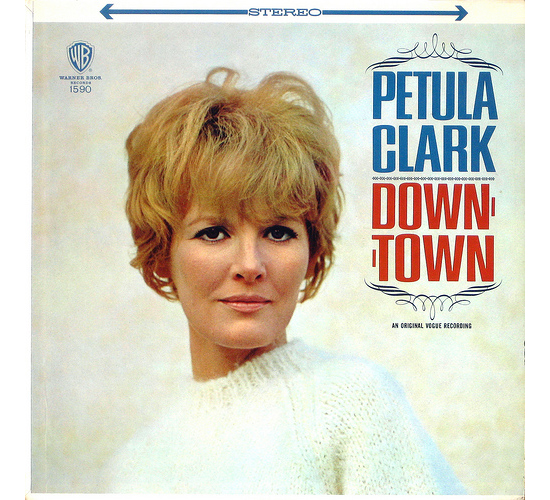
Eventually, our DJ rambled us back to December 1964 when Petula Clark’s Downtown was released in the U.S. We played it once and then we played it again, and as I sat there listening to that analogue recording on a cold winter’s night in a house very far uptown, it was like hearing Downtown for the very first time. And what really struck me was the silky optimism of Tony Hatch’s lyrics. Based, supposedly, on a recent trip to New York, the song offers traffic, neon, and noise as balm for the soul. But in the mid-60s, there were plenty of people who regarded those same urban effects as generators of blight, the kind of urban that was desperately in need of renewal. Though The Death and Life of Great American Cities had been around for a few years, and had already been called “significant” (by the New York Times, no less), it hadn’t spent 15 weeks at the top of the charts the way Clark’s single did. I’m not yet prepared to offer a theory of causality between the success of downtown, the song, and the rebirth of downtown, the place, but I’m working on it–because there’s a larger narrative here about the relationship of pop culture to urban discourse that is well-worth exploring. In the meantime, if anyone knows whether or not Jane Jacobs was in the audience for Petula Clark’s first American nightclub appearance, at Copacabana in October 1965, I’d be happy to receive the information.

Leave a Reply
You must be logged in to post a comment.